The history of Churchill Falls and Newfoundland and Labrador is the great tale of what-ifs. It is about the bargain of Confederation, what went wrong in the 1960s, and how those bad decisions and bad bargains have reverberated through Newfoundland and Labrador history and led the province to a difficult crossroads.

The story behind the story
Joey Smallwood
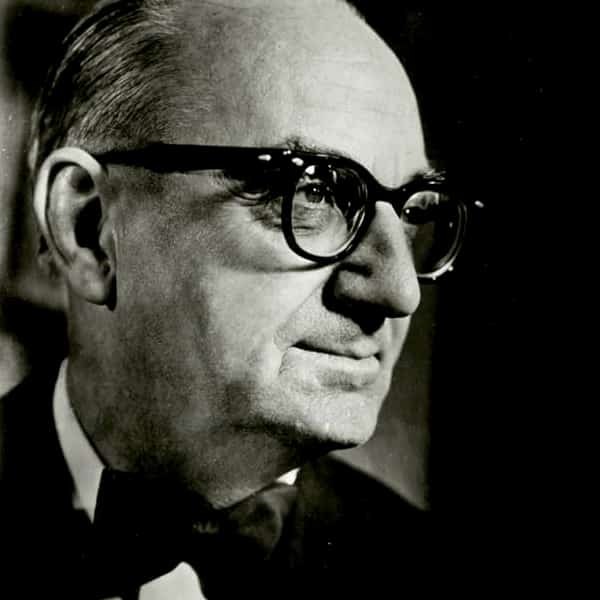 Joey Smallwood was Premier of Newfoundland and Labrador for 23 straight years, between 1949 and 1972. His campaign in the 1948 referendum for Canada was especially successful in smaller and remote fishing villages of the island. The final vote was 52% for Confederation with Canada and 48% for independence. Without Joey’s inspired campaign, it is safe to say that Newfoundland and Labrador would not have joined Canada at that time. Joey was a controversial figure through those 23 years. He was power-hungry and somewhat arrogant. He was a poor businessman and made many errors in personal investments. He was a poor judge of character and he was a difficult person to work with. He was conflicted in some of the investments and made a string of bad business decisions leading to losses.
But Joey also had a tremendous vision and love for Newfoundland and Labrador, and a deep and abiding drive to create a better life for his nation, one that had always existed on the edge of bankruptcy.
Despite his many attempts to kick start industrialization in the province, by the 1960s, Newfoundland and Labrador still lacked a broad-based economy. Joey’s aim was always to develop its natural resources and create meaningful jobs for his people away from the reliance on fish. Smallwood promoted investments in iron ore, forestry, refineries, and of course hydro developments. The biggest prize of all was Churchill Falls, a hydro development of enormous potential.
Joey assigned the rights to develop the project to Brinco, a company financed by the famous British banking Rothschild family, who started a subsidiary called the Churchill Falls Corporation Company (CFLCo).
The critical obstacle for Churchill Falls development was power transmission. Churchill Falls was and is isolated, in the center of Labrador, and the only realistic way to get power to markets in Ontario or the Northeast US was through Québec. The Québec Government refused to even consider allowing Brinco and Newfoundland and Labrador to build its own transmission lines across Quebec and insisted that any Churchill Falls power would have to be sold to Hydro-Québec at the Labrador border.
The transmission corridor was the only way Newfoundland and Labrador could negotiate a decent price for the immense power the reservoir could generate, some 34 billion kWh. Otherwise, Hydro-Québec held all the cards. Under the British North America Act, which was the Canadian constitution of the day, the new province of Newfoundland and Labrador had a right to demand a power corridor through Québec. This demand was never made.
Instead, Smallwood became obsessed with a letter of intent, which was designed to spur construction. The question of who would buy the power, and how much Newfoundland and Labrador would be paid for it, was left in the hands of Brinco and CFLCo.
The Letter of Intent
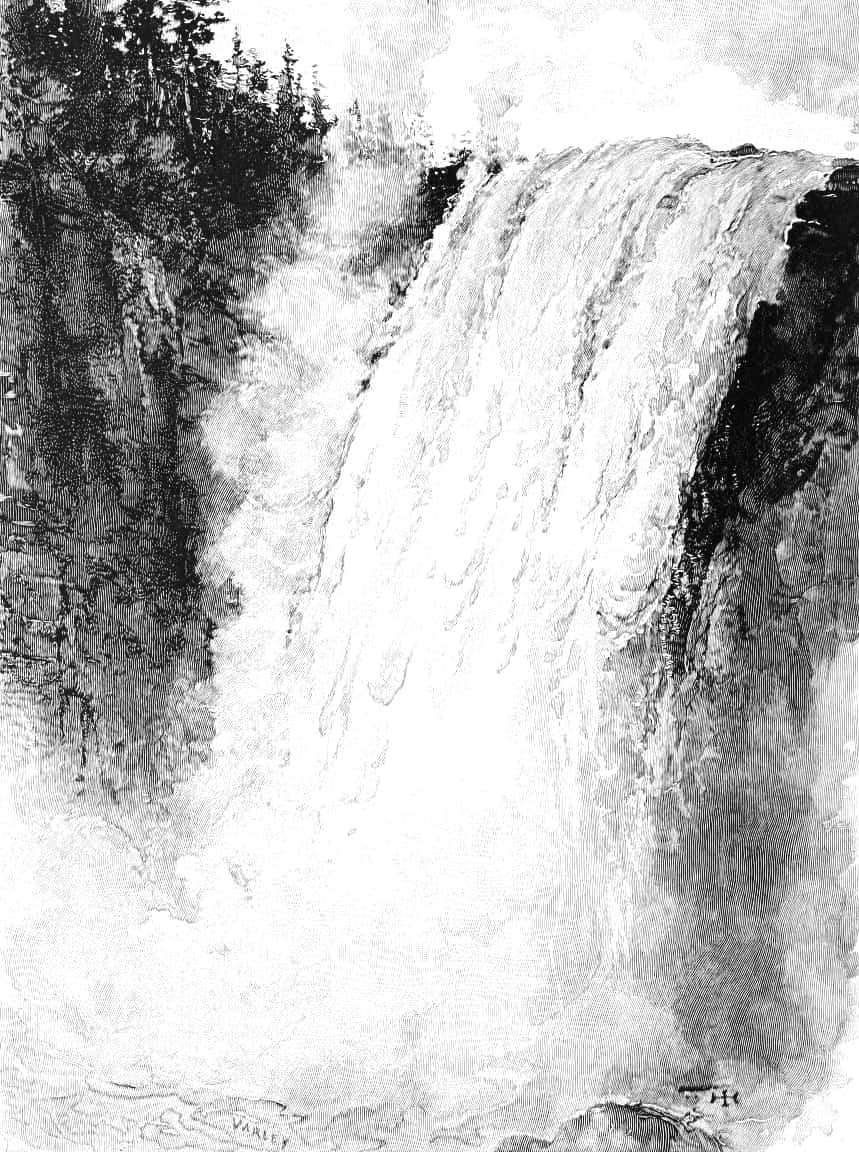
Churchill Falls in 1891.
Contrary to myth, Smallwood had little influence over the final terms of the Churchill Falls contract. Rather, what happened was within two weeks of signing the letter of intent Brinco and CFLCo started construction to meet what was a very aggressive timetable. CFLCo secured short term bank loans from the Bank of Montreal and started to borrow. In the process CFLCo were oblivious to the fact that a letter of intent has little legal strength. Such a document shows only an intent and is usually not strong enough to indicate any legal action. Borrowing and construction continued through to early 1968, when permanent financing had still not been secured and short-term funds ran out. Brinco was very, very close to bankruptcy. Because it was a private company, it had no choice but to cash in its only real asset – the power a Churchill Falls generation plant would eventually produce.
The investment bankers who included Morgan Stanley and some Canadian investment bankers foresaw the problem. They warned CFLCo, but did nothing to stop Brinco and CFLCo from continuing to borrow. Similarly, the finance department of Brinco and its operating company CFLCo were oblivious to the danger of borrowing short-term and by the late 1960s, they were in effect placed into a state of quasi-bankruptcy because they defaulted on their short-term debt obligations.
The Rothschild family, dissatisfied with the way permanent financing was going, and worried about their investments, asked Wood Gundy to intervene, and it was then that the truth came out. Permanent financing could not be completed on this project under any circumstances without the proper legal process. Wood Gundy at the time was not only the leading investment bank in Canada, but also had a strong role in Europe and the USA. Ian Steers in London, along with Bill Wilder and Ross Le Messier in Toronto, were among the leaders in investment banking at the time. Had they been in charge they would likely never have let the situation deteriorate to that stage because they would have stopped the short-term borrowing and obtained proper financing.
Hydro-Québec was a shareholder in Brinco and had both the assets and financial power to bail Brinco out. It was at this stage that the worst aspects of the Churchill Falls deal came into being.
The price for the power was set at $2.90 per MWH for the first years, then falling to $2.50 per MWH for the last 25 years, which started Sept 1, 2016, then following to just $2 and will not expire until Aug. 31, 2041.
Smallwood himself was obsessed with the thousands of construction jobs the project had created and encouraged Brinco to do whatever it took to get a deal done and save the project. His government was not even part of the discussion about power rates. They were neither consulted nor informed until the Churchill Falls agreement, with all its egregious language, was firmly in place.
The Contract
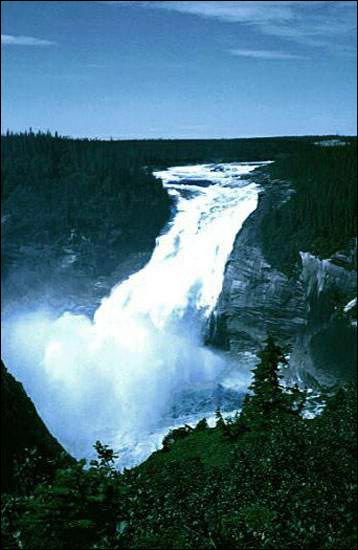
Churchill Falls in 1969.
The final terms of the Churchill Falls contract were negotiated between Québec and Brinco, on terms that characterized a company in bankruptcy, seeking relief from a wealthier competitor.
- Power rates for the electricity sat at $2.50 to $2.90 per MWH. By contrast Hydro-Québec was able to sell the power later at an average rate near $60 per MWH-showing the incredible returns Hydro-Québec made on this project.
- A 25-year extension in 2016 was made to the 40-year contract and the price was reduced to $2 per MWH.
- Control of over 50% ownership would revert to Québec if at least two turbines were not in operation within five years (in fact first power was produced on December 9th and 16th 1971, and this threat was avoided).
- In case of default, Hydro-Québec could squeeze out Newfoundland and Labrador and obtain 100% ownership.
- Hydro-Québec would gain control of CFLCo if $515 million in long-term debt and permanent financing was not in place by December 15, 1968.
- In case of dispute Québec law would prevail.
- CFLCo had no right to sell additional shares to anyone else but Hydro-Québec, should more shares be sold.
- Hydro-Québec gave a $100 million cost overrun guarantee and also absorbed much of the interest rate and currency risk.
- A final covenant, and the one that rubbed salt in the wound, was that preference in construction and services would go to Québec companies over Newfoundland and Labrador ones.
It was a dreadful and one-sided deal, one that robbed Newfoundland and Labrador of hundreds of billions of dollars, and lead to generations of anger and resentment in the province, which lost the benefits of its greatest asset.
Hydro-Québec's Role and Rates
 Hydro-Québec scored a windfall in the Churchill Falls contract. Estimates vary widely, but conservative estimates of the contract’s value suggest that Hydro-Québec’s present value of the contract is in the range of at least $250 billion. It was often selling the power for over $60 per MWH versus the cost of $2 to Hydro-Québec, which shows the one-sided nature of the contract. However, since then power rates in the Northeast US have come down considerably. Discovery of natural gas in the massive Marcellus and Utica gas fields in the Northeast US have driven power rates down to a $30-$40 per MWH. This cheap gas is used to generate electricity throughout the Northeast US.
Hydro-Québec ended up owning a 34.2% of the operating company, CFLCo. It helped in the final long-term financing in good faith and provided the last hundred million dollars by buying a $100 million debenture with warrants.
Hydro-Québec also provided a cost overrun risk of $100 million and provided currency and interest rate risk. It was a positive element in the final financing of Churchill Falls and used its own balance sheet and the strength of the credit rating of Hydro-Québec in getting the permanent financing done.
As far as ownership goes, Hydro-Québec in 1962 nationalized Shawinigan Water and Power and added value estimated at $2,225,000. It owned 20% of the Churchill Falls operating company, CFLCo. It assisted in financing, and for $15 million it bought 5% of CFLCo. And then it took warrants for adding the last $100 million (debenture) in the permanent financing which added 9.2% ownership at zero cost. Thus, Québec has 34.2% ownership in CFLCo for a total cost of $17.2 million, a real bargain. Meanwhile, the holding company Brinco itself had a wide range of owners. Brinco itself generally owned 60% of CFLCo. Québec close to 20%, Rio Algoma (Rio Tinto Zinc) 10%, and Newfoundland and Labrador itself owned 10%. At the end, the province bought everyone out except Québec for $160 million and it now owns 65.8% while Hydro-Québec owns 34.2% of the shares of CFLCo.
Construction of Churchill falls and the Financing
By all rights, completion of Churchill Falls should have been late with a charge cost overrun. The reason it worked so perfectly was the engineering was designed with great care, the scope of the project did not change, and the group had an almost perfect leader in Don McParland. A remarkable leader, Don negotiated an eight year no strike labor agreement. He set up a system to coordinate logistics, so parts and labour arrived in time. He created a timeline for each component and initiated worse-case risk management to anticipate strategies. There were 80 separate construction contracts with 50 companies successfully implemented. There was perfect coordination between McParland, Bechtel (the construction leader), and Acres, the designer of the project, where problems and decisions were coordinated. But to gain its speed and efficiency McParland initiated a program of short-term borrowing. When the short-term money ran out in the winter of 1968, Brinco and CFLCo were essentially placed into quasi bankruptcy, and Hydro-Québec was able to initiate the tough terms that emerged.
And further tragedy was to strike. McParland was to give a speech on Nov. 11, 1969, in the iron ore town of Wabush, Labrador. McParland had four other senior management members of CFLCo with him on the plane when it crashed into the face of the Wabush open pit iron mine. McParland and his colleagues were all killed in the crash.
However, fortunately for Newfoundland and Labrador the whole project was already fully mapped out and Bechtel, the construction company, rose to the occasion to complete the project under budget and on time. In a way, Newfoundland and Labrador was moderately better off, because in case of default Hydro-Québec would have ended up with 100% of the project. The financing closed in September 1968 and the coupon rate was 7.75% negotiated by Bill Mulholland of Morgan Stanley. This was ahead of the “Hydro-Québec gets control” date of December 15, 1968. By October 1968, interest rates were on the rise and one year later funding would have cost 9.25% (+1.5%.) By 1974, interest rates were 11.5%. The project would not have been financed in 1974 as debt service costs would have made this capital-intensive project uneconomic. If the project would not have happened the big loser would have been Hydro-Québec and the province of Québec. The present value of Churchill Falls was estimated by Québec in an SEC filing in 1989 to have been $250 billion.
What If?
The negotiations around Churchill Falls power did not happen in a vacuum. Governments in Newfoundland and Labrador, Québec and especially Ottawa were well aware that Newfoundland and Labrador had every right to a power transmission corridor through Québec. Yet politicians in Newfoundland and Labrador never pressed their case, handing Hydro-Québec an immense advantage in subsequent negotiations.
Newfoundland and Labrador proved that it could build the Churchill Falls generating plant. It was built under budget at $940 million, and 5.5 months early. It would have been possible for Newfoundland and Labrador to build a transmission corridor through Québec. Financing through contracts such as the Rothschild family and companies such as Rio Tinto Zinc could have provided a base to finance it, and Con Ed of New York, Ontario Hydro, and even Hydro-Québec would all have been possible customers for the province.
Instead, Newfoundland and Labrador never pushed its constitutional case for a power corridor, at least not in public, and when Brinco ran out of money, it started a chain of events that lead to the one-sided deal.
How did this Happen?
The political climate in Canada was a huge and silent cloud hanging over the whole affair.
In 1966, the country was under a Liberal government, led by prime minister Lester Pearson. Québec separatism was a growing threat, and Pearson’s government had a huge number of Québec MPs.
The winds of separatism grew into a hurricane in the summer of 1966, when legendary French President Charles de Gaulle proclaimed “vive le Québec libre” from the balcony of city hall in Montreal.
This call for Québec independence was greeted with excitement in Québec, and horror in Ottawa. Appeasing Québec, in any way possible, became the only political option for Pearson.
Under those circumstances Newfoundland and Labrador’s fate was cast. Subsequent events proved Pearson’s decision was the right one for the country. By 1970, his successor Trudeau had declared the War Measures Act to defeat the terrorist FLQ, and six years later came the first of two referendums which almost tore the country apart. In the second, Canada won by just 54,288 votes. If 27,000 people out of millions had voted the other way, Québec separation would have become inevitable, and Canada would have become a very different country.
Smallwood’s decision to support Lester Pearson, and Canada, and not ask for the transmission corridor for Labrador hydro power, robbed Québec nationalists of an issue which would have enflamed private citizens in Québec. In effect, Newfoundland and Labrador saved Canada – but paid a very high price.
Don’t Ask...
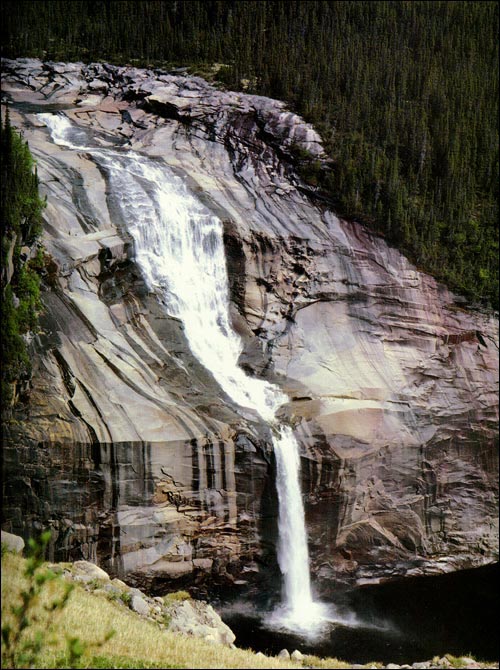
Churchill Falls in 1980.
It would be a few years before the most egregious aspects of the Churchill Falls deal became really obvious. In 1973 power prices soared, as a result of the Arab oil embargo. Hydro-Québec began reaping huge profits from Churchill Falls. Opinion in Newfoundland and Labrador turned against Smallwood, and generations later, the province’s politicians and citizens, struggling mightily without that source of revenue, are left seething at the injustice.
Even Smallwood himself came to regret his decision not to pursue the power corridor. Later in life he inferred that he had approached Lester Pearson for help in 1967, but that he had been turned away. Québec’s needs trumped Newfoundland and Labrador’s. While we have no historical evidence that such a meeting took place, we know two things:
- Smallwood knew that a power transmission corridor would be vital to Newfoundland and Labrador’s future interests.
- He was either persuaded or deliberately chose to ignore this fact, and instead focused on the benefits of the large construction project. The result was Brinco rushed into construction without enough money to build the project, and nearing bankruptcy, was forced to negotiate a terribly one-sided deal with Hydro-Québec.
We can only surmise why Smallwood made such a fateful decision, but we can speculate.
Although no one can question his loyalty to his home province, Smallwood was at heart a Canadian nationalist. He had almost singlehandedly convinced his fellow Newfoundlanders and Labradorians to abandon their own country and join a larger and more powerful federation. Newfoundland and Labrador would be infinitely better off within Canada, he argued, in a thousand different ways. How could that man, the man who had sold his people on Canada, come home and tell them that the bargain of Confederation was false? How could he tell them that it had all been a lie, that Confederation would not be fair, that Newfoundland and Labrador’s greatest asset would be sacrificed to preserve a much larger and more powerful province?
He couldn’t. And he didn’t.
In 1972, when the Churchill Falls generating station was officially opened, Smallwood, a man with a grand sense of occasion, did not even bother to show up for the ceremony. His greatest triumph as a premier was instead becoming his greatest humiliation.
History has judged him harshly. Within Newfoundland and Labrador, much of the good he did has been obscured by this one-sided deal. “No more giveaways” has become the rallying cry for every subsequent leader. Realistically, Hydro-Québec and Newfoundland and Labrador have many shared interests and opportunities, and Hydro-Québec should be an ally and partner with this province. Instead they are portrayed as an arch-enemy.
Fifty years later we can now see both sides of the story – while Smallwood and Pearson did the wrong thing, they did it for the right reason. Preserving Canada’s peace was a great good and enriched the lives of tens of millions of people. But it still wasn’t fair to Newfoundland and Labrador. And Canada, of all countries, is built on fairness.
And at this time, in Newfoundland and Labrador’s greatest need, it is time for the federal government to fix it.
The alternative for Canada and Newfoundland and Labrador
While Canada has alternatives, Newfoundland and Labrador increasingly has none, as it struggles to avoid insolvency. Even before Muskrat Falls, Newfoundland and Labrador has had a 15% unemployment rate, is losing population, receives half the transfer payments from the federal government compared to the three other Maritime provinces, has among the highest tax rates in Canada (with limited tax capacity), and has a population with an average age 15% higher than the Canadian average. The average age of Newfoundlanders and Labradorians in 2042 is estimated to be 66 years. The province will soon be a province of old age pensioners.
This means future skyrocketing health costs, with an aging population and more old people on the way. Finally, Newfoundland and Labrador has unsustainable debt levels approaching over 60% of GDP. With annual interest costs of $1 billion, the province is borrowing money to pay the interest. And all this is before the financial catastrophe of Muskrat Falls.
To finance Muskrat Falls, Newfoundland and Labrador will have to double electricity rates by 2022, to 24 cents per kWh. This will affect commercial/industrial firms substantially and severely affect the citizens of the province, where 50% of the electricity is used for heating.
If Canada does not support Newfoundland and Labrador, rather than freeze in the dark, the provincial government will likely have to intentionally default on $8 billion in federal guarantee debt. This will save Newfoundland and Labrador $300 million of interest and reduce debt levels by $8 billion. Newfoundland and Labrador has $4 billion in equity capital invested in Muskrat Falls and could dare the federal government to wipe out this investment. Canada would be stuck with paying off $8 billion in principal and at least $6 billion in interest under this scenario.
Three Options for Newfoundland and Labrador
Canada and the federal government have three options to deal with the current situation in Newfoundland and Labrador – the ‘Dignified’ option, the ‘Nuclear’ option, and the ‘Do Nothing’ option:
- Support Newfoundland and Labrador financially, and help the province to solve this problem with dignity and honour, and over time the province can pay its way out of the problem.
- Force Newfoundland and Labrador to use the ‘Nuclear Option’ and default on its debt to the federal government, which will totally disrupt the Canadian economy. The capital markets would turn on Canada and all the provinces, causing a sudden rise in interest rates and national instability.
- Do nothing and watch as Newfoundland and Labrador struggles with increasing futility to contain its rising interest costs, repay Muskrat Falls debt, still maintain public services, and grow the economy. This is impossible to accomplish.
The Best Solution – Saving Newfoundland and Labrador
There is no way the Newfoundland and Labrador Government can continue to pay interest on its constantly rising debts and still avoid disaster. Public services cannot be maintained under the current revenue while still paying the ever-rising interest and the new Muskrat Falls debt, and neither the public nor the economy will withstand the doubling of electricity prices. If the province defaults, it will shake the Canadian financial system to its foundations.
The only reasonable and dignified alternative is federal help.
The Dignified Option
In this option, the federal government pays 3 cents a kWh for 30 Billion kWh of electricity, and all the interest on the Muskrat Falls debt for 22 years. This figure represents the loss Newfoundland and Labrador currently incurs by selling all the Churchill Falls power at such a low price to Hydro-Québec. The federal government would also pay the interest on the current $8 billion Muskrat Falls loan it guaranteed.
Newfoundland and Labrador could then take over paying principal and interest after
2041 and repay all the Muskrat debt from the profits it will make from Churchill Falls, when it regains control over power sales.
The Dignified Option would cost $22 billion over 22 years for the federal government and would result in Newfoundland and Labrador treated with dignity and respect.
The Nuclear Option
Newfoundland and Labrador voluntarily defaults on the Muskrat Falls debt and interest guaranteed by the federal government. This would cost the Government of Canada approximately $15 billion, as it would mean that the federal government would be left to pay $8 billion in Muskrat Falls debt, and $7 billion in interest costs on that debt.
While this option would relieve much of the strain on Newfoundland and Labrador, it would also reverberate through world financial markets, which would lose confidence in Canada’s ability to manage provincial debts. This option could be used as a negotiation tactic by Newfoundland and Labrador to bring the federal government to the table, because if Newfoundland and Labrador arbitrarily takes this option, it could blow out spreads on all provincial debt, and cause a massive increase in interest rates for all the provinces.
The Do-Nothing Option
This is essentially where the province is now. Currently, Newfoundland and Labrador is fighting a losing battle to pay interest on its debts while still maintaining provincial services. And in two years the full burden of Muskrat Falls debt will fall on the province, forcing massive increases in electricity prices and/or cutbacks in services.
If the federal government does nothing, it will probably lead to default by Newfoundland and Labrador, which cannot sustain the level of debt and interest it is obligated to repay. With few other choices, the province will be pushed into taking the nuclear option.
In the 1960s, Newfoundland and Labrador’s financial future was sacrificed to keep the country together. Now, in the time of the province’s greatest need, it is the time for Canada to step up and repay that debt.
SIDEBAR: Equalization — Why does Newfoundland and Labrador Lose Out?
The way the fiscal situation works in Canada, the federal government has been assigned to do the majority of the tax collection in Canada. The federal government transfers tax funds collected to the provinces, who do the bulk of the spending. In theory this is good policy, as it has stabilized tax collection in Canada and has made taxation more equitable across the country. Currently, the federal government in Canada spends roughly one quarter of its revenue and transfers much of the rest to the provinces, to individuals, and to corporations.
Transfers are made under three major programs. The health component is the most important and transfers to the provinces roughly $40 billion. Growth in this transfer is capped at 3% annually, or only $1.2 billion per year growth. Unfortunately, demand for health services is growing roughly at 8% annually in Canada, or $3.2 billion which is a serious problem for the provinces. Health is by far the greatest problem for the Canadian provinces, who are faced with a rapidly aging population, as people live longer and require more expensive and sophisticated drug and medical treatments. Somehow the provinces are also now expected to add free Pharmacare to the health list, from an already heavily strained health system. And this is within a tax system where provincial tax capacity is rapidly being eroded.
The second program provides funding to social services and education, amounting to about $15 billion annually, which the federal government has also capped at 3% growth. The third federal transfer program is the Equalization Program, which is designed to help equalize services between the poorer and wealthier provinces and amounts to about $20 billion annually. It is also capped at 3% annual growth or about $600 million per year.
For Newfoundland and Labrador, this is the greatest disappointment, because despite its desperate financial straits, the province is considered a ‘have’ province, and gets no Equalization payments under the formula.
The reasons why the present treatment of Equalization is unfair to our province are as follows:
- The province has to include 50% of its oil revenue in calculation of benefits. This is terribly unfair to Newfoundland and Labrador because it is not in the class of Alberta and Saskatchewan. All three provinces have many of the benefits of oil and gas clawed back, thereby neutralizing the benefits of oil and gas. Thus, the $1 billion that Newfoundland and Labrador collects in oil royalties is partly clawed back under the formula and neutralized. Furthermore, because the formula is based on per capita taxation, the sheer size of any one province can overwhelm the fixed amount of Equalization payments contributed by the federal government. With about one quarter of Canada’s population, Québec receives $13 billion of the $20 billion Equalization formula, or about two thirds of the total Equalization payment for the whole country.
- Newfoundland and Labrador gets nearly 17% of its revenues from federal transfers, versus 35% for the other Maritime provinces. This makes no sense since Newfoundland and Labrador is in greater need than any of the three other Maritime provinces.
- The federal government recently quickly and quietly renewed the Equalization formula for five more years without change, and without proper consultation with the provinces.
This was horribly unfair to Newfoundland and Labrador, which has an unemployment rate of 15%, has had negative GDP growth over the last 5 years, is experiencing a decrease in annual population of 3,000 people per year, has three aging oil fields, is sensitive to the volatile price of oil, and has a population base 15% older than Canada.
There is evidence that technical factors in the Equalization formula calculation also hurt Newfoundland and Labrador. Many workers from Newfoundland and Labrador who worked in Alberta at high wages on turnaround construction jobs actually field their tax returns in Newfoundland and Labrador, and their high incomes inflated Newfoundland and Labrador’s Equalization tax calculations. With cutbacks and construction projects ending in Northern Alberta, this source of income for Newfoundland and Labrador is ending. Meanwhile, the current Equalization calculation will last another five years, despite the fact that many of these workers are now earning far less within their home province. The federal government recently quickly and quietly renewed the Equalization formula for five more years, capped at an annual growth of 3%.
Similarly, within the past year, three mega-projects in Newfoundland and Labrador have ended. These had also inflated the tax stats of the province, as so many of the workers were highly paid skills tradespeople. Under the averaging mechanism of the Equalization formula, it will take Newfoundland and Labrador three years before this loss of provincial income is recognized.
The graph below summarizes Newfoundland and Labrador’s financial situation within the Canadian context. It is not a pretty picture.
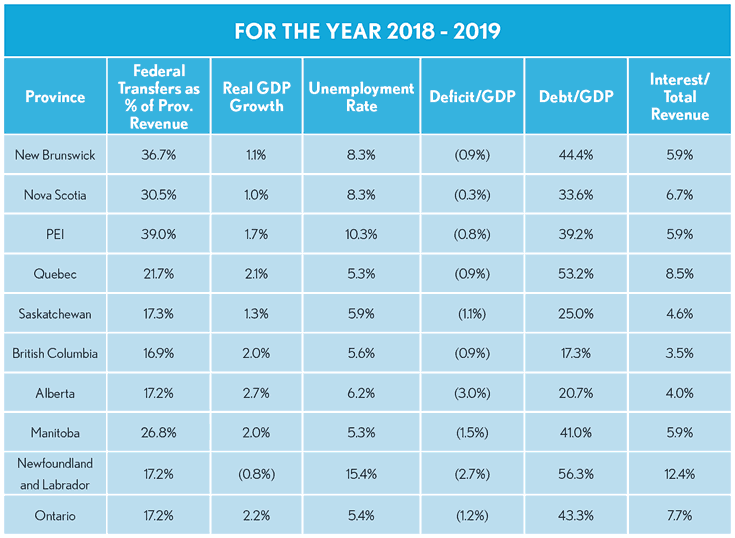 *Table shows Newfoundland and Labrador ranks lowest in all categories. *Based on 2018 reports from DBRS.
Newfoundland and Labrador is also heavily affected by the caps and restrictions that exist on the other two federal transfers. For example, if the federal government raised their proportion of health costs to 25% of health expenditure, Newfoundland and Labrador would immediately benefit by 1.4% of GDP, or about $400 million. Removal of the cap on Equalization would help Newfoundland and Labrador by close to another $400 million. These small policy changes would result in roughly $900 million a year to Newfoundland and Labrador, which would make an enormous difference to the province. It also shows how poorly Newfoundland and Labrador is treated by Canada on a fiscal basis. No other province in Canada would see such improvements, with relatively minor changes in transfer programs. It lays the basis for Canada to fix the Equalization and transfer programs, and work to improve Newfoundland and Labrador’s return to fiscal stability.
SIDEBAR: The Challenge of Muskrat Falls
Muskrat Falls presents some significant and massive challenges for Newfoundland and Labrador, ones which almost certainly will require federal government help if the province is to recover from them. First among these is the fact that Hydro-Québec controls the water flows of the Churchill River, via the Churchill Falls reservoir, to the year 2041. Hydro-Québec has been using this practice to great advantage in several ways. It can import power after midnight or at night and conserve water. The water behind the dam at Churchill Falls is enough to supply its generators only about 70% of the time. Thus, by importing US power after midnight at cheap spot rates, it is able to maximize average prices it receives for power. In the day with rush hour in New York, spot rates for power can rise dramatically, and Hydro-Québec can release water into the Churchill Falls generating station. Also, by maximizing power sales at peak summer and winter months, it assures top electricity prices for itself through the peak times.
In the shoulder season when demand is lower, it can cut back electricity production dramatically if needed, so that down the road it can maximize return from the water stored behind the Churchill Falls dams. The power is then sold at the much higher peak prices. The problem for Nalcor’s Muskrat Falls dam, which lies downstream from Churchill Falls, is that the new reservoir has very limited water storage capacity.
Hydro-Québec is going to continue to cut back and vary production from Churchill Falls in its own corporate interests, as it always has done for almost 50 years. Therefore, as Hydro-Québec stores water in the Churchill Falls reservoir, and subsequently cuts production from the Churchill Falls hydro system, this water will be unavailable to the Muskrat Falls system and generating plant. At critical times, Hydro-Québec may only allow enough water downstream so that production from Muskrat Falls will be estimated to be as low as 170 MW or 20% of Muskrat Falls capacity. At 170 MW power, Muskrat Falls produces only 1.5 billion kW. This is barely enough to cover the power the province is obligated to deliver to Nova Scotia’s Emera utility.
And because Muskrat Falls does not have enough water capacity, it can’t arrange long-run power contracts – like the $40 per MW hour contract Hydro-Québec just signed with the state of Massachusetts – due to the fact that Nalcor can’t guarantee the availability of its power, all because it does not control its water supply. Instead, it must try selling spot power at prices likely below $10 per MW hour. Or worse, try and sell it back to Hydro-Québec at whatever that utility wants to pay.
In a sad echo of history, Newfoundland and Labrador has no bargaining position, and is at the mercy of Hydro-Québec’s pricing, just as it was while developing Churchill Falls 40 years ago. Nothing seems to have changed for the province.
Secondly, the initial plan was to have Nalcor’s island-based customers absorb 2 billion kWh themselves, thereby allowing the closure of the thermal based generator at Holyrood and realizing some cost savings. But now, as the price of power doubles to 24 cents per kWh, it is questionable whether Newfoundland and Labrador will ever need the power. This is prohibitive for the residential customer in Newfoundland and Labrador, where half the power is used for heating. Many on the island will turn to wood or otherwise curtail consumption. In the case of the industrial and the commercial customer, the effects will be a massive strain, and energy intensive businesses will struggle to survive. The net effect will be very little increase in demand for power, and the 2 billion kWh destined for Newfoundland and Labrador from Churchill Falls won’t be needed.
Thirdly, in the original plan the 2 billion kWh per year were destined for US customers. However, there is little evidence such customers exist. Not only is there little market for this power but it is unclear that there is even enough transmission grid to carry the power to the customer. Close to 3-4 billion kWh or 50%-80% of Muskrat Falls power could be stranded.
Fourthly, with the uncertainty of having enough water to produce power, the thermal generation station at Holyrood will not be able to close, and that savings of $150 million will not be realized. Holyrood will have to stay open to provide backup power, as the Muskrat Falls transmissions may be unreliable at peak times.
Finally, the annual interest on Muskrat Falls debt is approximately $500 million on the $8 billion of debt guaranteed by the federal government, and the roughly $4 billion that Newfoundland and Labrador borrowed to increase its equity investment in Muskrat Falls. This principal, plus the interest, ultimately must be repaid by the province. This is impossible without federal help. Newfoundland and Labrador was in trouble even before Muskrat Falls, but this development has created an impossible predicament.
SIDEBAR: Is the Province Going Bankrupt?
Newfoundland and Labrador is in a precarious position fiscally, and with the additional debt of Muskrat Falls, it is in a state approaching insolvency for a province. This would be the first such case of provincial failure since Saskatchewan in 1993 when the Conservative federal government came to the rescue of this NDP government.
Reasons for this risk of insolvency are as follows:
- The province’s small population cannot carry its present debt load; and much of the annual $1 billion to pay the interest on the debt is being borrowed. This cannot continue indefinitely, and the longer the problem persists the worse it gets.
- The debt load now exceeds 60% of GDP, and is growing faster than the economy, thus resulting in ever growing interest expenses.
- The economy is hurt by the fact that three mega-projects have ended at the same time, causing a spike in unemployment and taking cash out of a struggling economy.
- Under the arcane rules of federal Equalization, the province is considered a ‘have province’, and so despite its crushing debts, poor economy and high unemployment, it receives little in the way of federal Equalization transfers.
- The province’s demographics are working against it, with a swiftly aging population and steady outmigration of younger people. This has the effect of both weakening the economy and increasing costs for the government, as the aging population demands more and more health services.
- With a small population spread over a large land mass, it is very expensive to deliver government services in Newfoundland and Labrador.
There is no question Newfoundland and Labrador went on an ill-advised spending spree after 2006, and partly created its own problem, but this is cold comfort to the people who live there now and are faced with resolving these crushing problems.
The bitter icing on the cake is that by 2021/22, the province will need to start to pay interest costs of about $500 million annually on Muskrat Falls debt. This would be added to the hundreds of millions of dollars per year that it already has to pay on its current debt. For a province with barely 500,000 people, this is a horrendous burden.
The Muskrat Falls debt is scheduled to be covered by rising electricity prices. Under current legislation, this requires a doubling of electricity prices in Newfoundland and Labrador by 2021/22. Given that half of electricity on the island is used in heating, and that most people and businesses cannot afford increases of this magnitude, without federal help there will be an enormous hardship on people in the province.
The problems of Newfoundland and Labrador are much too big to overcome by itself. The province is edging into insolvency and needs help from Canada.